



Rwanda
Rwanda’s President Kagame expected to win a fourth term


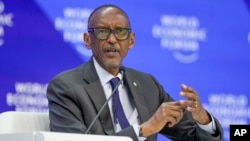
Rwandans will decide on July 15 whether to grant a fourth term to President Paul Kagame,, the country’s ruler since 2000. The country’s National Electoral Commission received a total of nine applications but only cleared three, excluding one of Kagame’s fiercest critics, Diane Rwigara. VOA’s Nairobi Bureau Chief Mariama Diallo has this report from the Rwandan capital, Kigali.
Rwanda analyst says UK migrant plan would help address illegal migration

A consultant working for Rwanda’s government says the asylum deal signed with the United Kingdom which was ditched last week by Britain’s new Prime Minister Keir Starmer would have helped address increased illegal migration. Gatete Ruhumuliza, a Rwandan Governance consultant, explained more in this interview with Associated Press.
Former journalist plans to challenge Rwanda’s sitting president in upcoming election
UK plans Rwanda deportations for early July, small boats continue crossing Channel
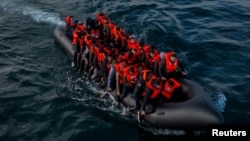
Migrants on small boats continued crossing the Channel into England on Saturday, despite the United Kingdom’s government on Friday saying it expects the first deportation flights to Rwanda to take off between July 1 and 15.
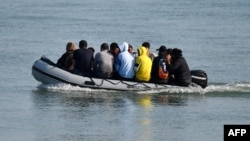
Dozens of people in two rubber dinghies reached the southern coast of England on Saturday, the latest among thousands of asylum-seeking migrants to make the risky sea crossing from France this year.
Bobbing on the waves of the English Channel on a clear morning, the boats sailed across the narrow strip of sea separating France and Britain, with a French naval vessel following them until they reached English waters.
Their largely male passengers, some of whom were in orange life jackets and waving, were taken aboard a British Border Force vessel off Dover.

The arrivals illustrate the difficulties British Prime Minister Rishi Sunak faces on his pledge to tackle illegal migration and "stop the boats," ahead of a national election expected later this year.
More than 8,000 people so far have arrived on British shores this year on small boats, with many fleeing war or famine and traveling through Europe.
Sunak hopes his flagship Rwanda policy to deport those arriving in Britain without permission will deter people from making the Channel crossing.
Five people died in the attempt to cross the Channel last month.
Prior to Saturday’s report of ongoing illegal migration in Britain, authorities told the High Court in London that they expect the first deportation flights to Rwanda to take off between July 1 and July 15, Judge Martin Chamberlain said on Friday. He disclosed the dates as he set a hearing for a forthcoming legal challenge to Sunak’s controversial policy by the FDA union, which represents civil servants and public officials.
The FDA wants a judicial review of a newly passed law that declares Rwanda safe, despite a U.K. Supreme Court ruling that said the removals of asylum seekers were illegal.
The union wants clarity about whether the Safety of Rwanda (Asylum and Immigration) Act complies with the Civil Service Code. Under the code, the U.K.'s politically neutral civil servants are legally obliged to "uphold the rule of law and administration of justice."
The new law allows ministers to ignore parts of domestic and international human rights law when deciding on deportations, as well as any "Rule 39" injunctions from the European Court of Human Rights. That would create a potential conflict, the FDA argues.
"Civil servants should never be left in a position where they are conflicted between the instructions of ministers and adhering to the Civil Service Code," said FDA general secretary Dave Penman.
"Yet that is exactly what the government has chosen to do," he said on Wednesday when lodging the judicial review application.
Judge Chamberlain decided that the FDA challenge would be held over one day in the first week of June.
"It appears from the claim that some civil servants believe, or have been advised, that it would be contrary to their terms and conditions to comply with a ministerial decision to proceed with Rwanda removals in the face of a rule 39 measure," the judge said.
He added that there was "a powerful public interest in the determination of this claim in advance of the point when any rule 39 measure might be indicated".
The Conservative government's Rwanda policy is designed to deter huge numbers of migrants trying to get across the Channel to the U.K. from northern France on small boats. It said this week it had begun detaining failed asylum seekers with a view to deporting them to Rwanda, sparking protests.
Information for this article was sourced from Reuters and Agence France-Presse.
UK begins detaining migrants for Rwanda program, human rights groups resist

British authorities on Wednesday began detaining migrants in preparation to send them to Rwanda in the next nine to 11 weeks, laying the groundwork for Prime Minister Rishi Sunak’s flagship policy.
A statement released by Britain’s Interior Minister James Cleverly said “enforcement teams are working at pace to swiftly detain” migrants who entered the nation illegally.
While Cleverly released his statement, the nation on Tuesday sent its first asylum seeker to Rwanda under a voluntary scheme which is separate from the deportation policy, The Sun Newspaper reported.
Official data shows that over 7,500 migrants have arrived in England on small boats from France in 2024. Sunak’s government says the deal with Rwanda is focused on addressing illegal migration.
Cleverly’s ministry on Wednesday released images of a man being detained by immigration enforcement officials, while another was led out of his house in handcuffs. These were released after the National Crime Agency, NCA, last week said it arrested three Africans who were facilitating illegal migration into Britain.
Care4Calais, a refugee charity, said the detentions started on Monday.
A spokesperson said the group's helpline received calls from "tens of people," adding that they still did not know who would be earmarked for the first deportation flight, or when it would be attempted.
Natasha Tsangarides, the Associate Director of Advocacy at charity Freedom from Torture, says “people are very frightened.”
The fear of being detained and sent to Rwanda has pushed “some people to go underground and disengage with their support system,” Tsangarides said.
Despite the attempts by British authorities to curb ongoing illegal migration, several human rights organizations say Sunak’s administration should abandon the plan to send people to Rwanda.
Yasmine Ahmed, the U.K.’s Director for Human Rights Watch, HRW, says the deal with Rwanda “is a violation of human rights on multiple fronts.”
Last November, Britain’s high court followed through on a verdict by a lower court which ruled that Rwanda is not a safe destination for the asylum seekers. However, in April 2024, lawmakers passed the “Safety of Rwanda Bill,” which compels judges to regard Kigali as a safe destination.
The U.K. government “is trying to make fiction fact” by determining Rwanda as a safe country, Ahmed told VOA.
“What we see in Rwanda is significant repression of anyone who challenges Kagame (the president) on anything really,” the HRW authority said, adding, “we see that there are journalists who are currently imprisoned and there is depression of political activity.”
The FDA, formerly known as the Association of First Division Civil Servants, a British union focused on representing civil servants, says it plans to challenge the Rwanda plan on behalf of its members who will be impacted.
FDA was instructed to help enact the policy, but “civil servants should never be left in a position where they are conflicted between the instructions of ministers and adhering to the Civil Service Code,” said Dave Penman, the FDA’s general secretary.
Political experts say they expect other unions and human rights organizations to join the FDA in lodging legal challenges against the government to stop the flights to Rwanda from taking off.
VOA's Carol Van Dam contributed to this report. Some information was sourced from Reuters.
Ireland says UK Rwanda asylum deal is driving migrants over its border
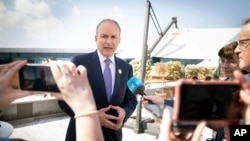
DUBLIN — The threat of deportation to Rwanda is causing migrants to head for Ireland instead of staying in Britain, Ireland's minister of foreign affairs and defense told a British newspaper on Friday.
British Prime Minister Rishi Sunak's flagship program to send asylum seekers to Rwanda if they arrive in Britain illegally was approved by parliament earlier this week and the government wants the first flights to take off in 10-12 weeks.
Ireland’s Minister of Foreign Affairs and Defense Micheal Martin told The Daily Telegraph that the policy was already affecting his nation because people were "fearful" of staying in Britain.
Martin said asylum seekers were seeking "to get sanctuary here and within the European Union as opposed to the potential of being deported to Rwanda."
The border between Northern Ireland, which is part of the United Kingdom, and the Republic of Ireland, a European Union member, is the only land border between the U.K. and the EU since Britain left the bloc.
That border is effectively open, with no immigration checks - a key condition of the deal that took Britain out of the EU in 2020, designed to avoid creating a flashpoint given the island's sectarian history.
Earlier this week, Ireland's Minister of Justice Helen McEntee told a parliamentary committee she estimates that more than 80 percent of people applying for asylum in Ireland are coming from Britain over the land Border with Northern Ireland.
King Charles signs off on Britain’s Rwanda asylum legislation

Britain’s King Charles gave his assent to legislation central to Prime Minister Rishi Sunak's plan to send asylum seekers to Rwanda. This happened while police authorities in the U.K. said they arrested nationals from Sudan and South Sudan who were facilitating illegal migration into the nation.
Royal Assent is the final stage in the legislative process, and effectively rubber stamps the decision taken by parliament earlier this week to approve the bill after a long battle between the government and opponents of the plan.
The Royal Assent was announced in the House of Lords on Thursday, meaning the Safety of Rwanda (Asylum and Immigration) Bill will now become law.
Parliament approved the legislation in the early hours of Tuesday morning. On Monday, Sunak said he expected the first flights to Rwanda to take off in 10 to 12 weeks after it was passed.
While British authorities signed off on the deal with Rwanda, police in the nation announced the arrest of another man, after five migrants, including a child, died this week trying to cross the Channel from France.
Britain’s National Crime Agency, NCA, said it arrested an 18-year-old from Sudan late Wednesday on suspicion of facilitating illegal immigration and entering the U.K. illegally.
The arrest came as part of an investigation into the Channel small boat crossing which resulted in the deaths of five people on a French beach on Tuesday.
The NCA detained two Sudanese nationals aged 19 and 22, and a South Sudan national, also 22, on Tuesday and Wednesday, also on suspicion of facilitating illegal immigration and entering the U.K. illegally.
The 19-year-old has been released without charge, and is now being dealt with by immigration authorities, the NCA said.
The latest arrest took place at Manston in Kent, southeast England, and the suspect was taken into custody for questioning.
Three men, a woman and a seven-year-old girl lost their lives in the early hours of Tuesday in the sea near the northern French town of Wimereux. They had been in a packed boat that set off before dawn but whose engine stopped a few hundred meters from the beach. Several people then fell into the water. About 50 people were rescued and brought ashore but emergency services were unable to resuscitate the five.
Fifteen people have died this year trying to cross the busy shipping lane from northern France to southern England, according to an AFP tally.
That is already more than the 12 who died in the whole of last year.
Some information for this article was sourced from Reuters and Agence France-Presse.
Rwanda, Tanzania and Zimbabwe Recall Johnson & Johnson Children’s Cough Syrup

KIGALI, RWANDA — Drug regulators in Tanzania, Rwanda and Zimbabwe have recalled a batch of Johnson & Johnson children's cough syrup as a precautionary measure after their Nigerian counterpart said laboratory tests found high levels of toxicity.
The three nations join Nigeria, Kenya and South Africa in recalling the same batch of the syrup, which is used to treat coughs, hay fever and other allergic reactions in children. South Africa has also recalled an additional batch.
Laboratory tests on the syrup by Nigeria's health regulator showed a high level of diethylene glycol, which has been linked to the deaths of dozens of children in Gambia, Uzbekistan and Cameroon since 2022 in one of the world's worst waves of poisoning from oral medication.
Diethylene glycol is toxic to humans when consumed and can result in acute kidney failure.
The batch of Benylin Paediatric syrup recalled was made by J&J in South Africa in May 2021, although Kenvue now owns the brand after a spin-off from the multinational pharmaceutical company last year.
Tanzania Medicines and Medical Devices Authority, TMDA said it had begun the recall on April 12 after hearing about the Nigerian test results.
"This is an exercise that does not involve investigation but rather monitoring to ensure that those affected drugs are removed from the market," TMDA spokesperson Gaudensia Simwanza said on Monday.
A spokesperson for Kenya's drug regulator said its test results on the syrup would likely be ready on Wednesday.
"A review of our safety database doesn't reveal any adverse events reported," the Rwanda Food and Drugs Authority said in a statement dated April 12.
"However, Rwanda FDA issues the present recall for precautionary measures," the statement added.
Zimbabwe's Medicines Control Agency said that it did have a record of the product's importation into the southern African nation, but that it was concerned the syrup could enter the local market illegally.
Zimbabwean authorities say the nation will step up inspections as a precautionary measure.
Kenvue said in a statement that it was conducting its own assessment and working with health authorities to determine a course of action.
Couple Lost Nearly All Relatives in Rwanda’s 1994 Genocide, They Seek Justice

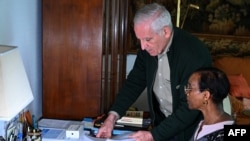
REIMS, FRANCE — Dafroza Mukarumongi-Gauthier, who lost nearly all her family in the 1994 genocide in Rwanda, tells rapt schoolchildren how she and her husband have for three decades tracked down genocide suspects who have found refuge in France.
For 30 years Mukarumongi-Gauthier, 69, and Alain Gauthier, 75, have dedicated much of their spare time and now in retirement to trawling parts of Rwanda searching for evidence of ex-killers, prisoners and survivors.
"When we've spotted the killer in France, we go to the scene of the crime," Mukarumongi-Gauthier told the French pupils. "We look to see if there are survivors and we begin the investigation."
Ahead of the 30th anniversary of the genocide beginning on Sunday, the couple addressed around 100 high school students in the northern French city of Reims.
Known as the Klarsfelds of Rwanda after the Nazi hunters Beate and Serge Klarsfeld, the couple have made it their life's duty to "end impunity" of those responsible.
Over 100 days between April and July 1994, more than 800,000 minority Tutsis and moderate members of the Hutu majority were killed, in massacres orchestrated and inflamed by the authorities.
Rwandan-born Mukarumongi-Gauthier’s own life was utterly devastated. In late February of that year, she went to Kigali to see her family. Tensions were already high and Hutu militiamen were stationed in the capital.
'Abyss' of pain
Her mother urged her to flee to France but she could not persuade her family to leave, she told AFP, her face bearing traces of the enduring pain three decades on. She would never see them again.
Her mother, Suzana, was shot outside a church in a Kigali parish where she had taken refuge. Mukarumongi-Gauthier lost as many as 80 family members, with no survivors on her mother's side.
"It's an abyss -- all these deaths that inhabit us," she said.
For several years, the Gauthiers have gone into schools and universities in an effort to pass on the memory of what happened.
The Reims students listened to the horrific testimony of survivors, viewed archive images and watched a film showcasing Gauthiers' work.
Abylou Taiclet-Andre, 18, said it had made all the difference to their understanding, as in school they just learned figures and it remained "vague."
"Whereas here, we had people who could bear witness and we had very touching witness accounts," she said.
'Complacency'

Rwanda has long accused France, which maintained close relations with the then Rwandan Hutu-dominated regime, of complicity.
In 2021, a commission of historians set up by President Emmanuel Macron concluded that France had "heavy and overwhelming responsibilities" for the tragedy.
This week, Macron said ahead of the anniversary that France and its Western and African allies "could have stopped" the genocide but did not have the will to do so.
Historical links between Paris and the regime of then, Rwandan president Juvenal Habyarimana — whose death sparked the violence — helped many of those responsible find refuge in France after 1994, the Gauthiers say, lashing out at French "complacency."
They became doctors, priests, municipal employees and led anonymous lives.
The Collective of Civil Parties for Rwanda, which the Gauthiers co-founded in 2001, is behind the bulk of more than 30 legal cases filed in France against Rwandan nationals.
To date, seven men have been sentenced in France for their participation in the genocide, to sentences ranging from 14 years in jail to life imprisonment.
France is, along with former colonial power Belgium, the European country from which Rwanda has urged the most extraditions of suspects -- 42.
France's highest court has consistently opposed extradition to Kigali on the grounds that the crime was not on Rwandan statute books at the time of the massacre.
'Our duty'
The Gauthiers have traveled to Rwanda three or four times a year, shrugging off sleepless nights haunted by witness accounts of the horror.
"Fortunately, we did this work for the sake of justice," Alain, a French-Rwandan national, said.
"Had we not committed ourselves, I think that no genocide perpetrator would have been tried and convicted today in France.
"It is regrettable that this justice system has relied for so long on the initiative of a few basic citizens like us... It was not until 2019 that the prosecution took the initiative to prosecute and open judicial investigations against people suspected of having participated in the genocide," Alain notes..

Mukarumongi-Gauthier believes that "justice allows you to mourn." "What we do with a trial is rehabilitate victims, say their names and what they were," she said.
"This is the moral restitution the victims expect" and require, she added.
Given that countless victims ended up in mass graves and remain unidentified "their only grave... the only worthy burial we can offer them is justice" itself.
"These trials had to take place in order to strip away impunity," she said.
The couple are due to attend the commemoration in Kigali on Sunday, an event Mukarumongi-Gauthier says is important for those born after the genocide.
"We remember in our hearts almost daily. We have been living with this for 30 years," she said emotionally.
But, says Alain, "we will have done our little bit towards reconciliation in Rwanda. We did our duty."
Remaining Leaders Responsible for Rwanda Genocide Must be Pursued, Rights Group Says
NAIROBI, KENYA — Human Rights Watch said Tuesday there was an "urgent need" to pursue the remaining leaders of the 1994 genocide in Rwanda, five days before commemorations begin marking the 30th anniversary.
Instigated by the Hutu extremist regime in Rwanda at the time, the United Nations estimates that around 800,000 people, mostly from the Tutsi minority, were killed over 100 days in an ethnic pogrom.
HRW said in a statement that "a significant number of individuals responsible for the genocide, including former high-level government officials and other key figures behind the massacres, have since been brought to justice."
But the rights group added that "in recent years, several high-level alleged genocide masterminds have died, or, in the case of one alleged planner, been declared unfit to stand trial, highlighting the urgent need to continue the quest to deliver justice."
In June, a U.N. court in The Hague declared that a presumed funder of the genocide now in his 80s could not be tried because of his deteriorated mental state.
International prosecutors determined in November that Aloys Ndimbati, one of the last remaining fugitives suspected of playing a major role in the killings, had in fact died in Rwanda in 1997.
Two senior genocide suspects are still on the run.
Rwanda's Paul Kagame Endorsed by Ruling Party to Seek Another Term
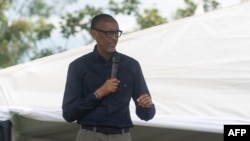
KIGALI — Rwanda's President Paul Kagame was on Saturday endorsed by his ruling party as its candidate in a presidential election due in July, potentially extending his rule in the eastern African nation of 13 million people to around three decades.
Kagame has been president since 2000 although he has been effectively in control since his rebel force marched into Kigali in 1994 to end a genocide.
At a meeting of top officials of the ruling Rwandan Patriotic Front, RPF, in the capital Kagame was endorsed by 99.1% of votes cast.
"We know where this country has come from, I appreciate the apparent role you have played in that. I also appreciate the trust that you always and continue to place in me," Kagame said after he was endorsed.
"The burden you have given me I have accepted to carry."
Voters will elect their next leader for a five-year term on July 15. They will also be electing their lawmakers.
At the last election in August 2017 Kagame won his current seven-year term with 98.63% of the vote, according to the electoral commission.
In 2015 Rwanda changed its constitution, meaning Kagame is now only eligible to seek a maximum of two five-year terms after the current one ends this year.
He has drawn international applause for presiding over peace and economic growth since the end of the 1994 genocide, in which about 800,000 ethnic Tutsis and moderate Hutus were killed.
But he has also faced mounting criticism for what human rights groups say are the suppression of political opposition and the muzzling of independent media.
In the July vote, he is widely expected to face Frank Habineza from the Green Party among other opposition candidates.
Rwandan Female Executive Encourages Financial Literacy

Studies show that one of the main challenges contributing to financial exclusion for women in Africa is the existing gender gap in access to banking services. This can be attributed to several factors including cultural norms, limited financial literacy, and restrictive social structures. As one of the few top female banking executives in Africa, Patience Mutesi, the Managing Director of Rwanda’s BPR Bank, knows all too well some of the hindrance that women face in accessing and utilizing formal financial services. She tells VOA's Jackson Mvunganyi financial exclusion limits women's ability to save, invest, and build a financial safety net for their families.
Rwandan Cowboy Provides Tourists With an Authentic Cultural Experiences of his Homeland

Alexis Ngabo Karegeya is a Rwandan Cowboy and tour operator based in Bigogwe, an area in North Western Rwanda.
Forum