



Tunisia
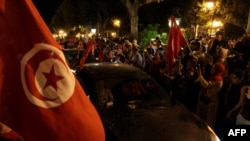

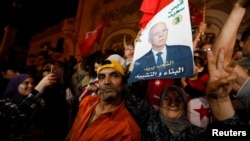
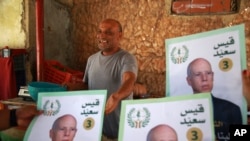
Tunisian president shakes up his government ahead of upcoming elections
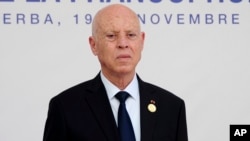
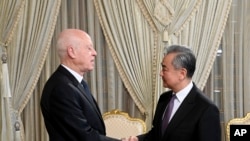
Tunisia and China are working toward building a strategic partnership
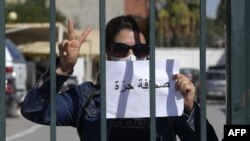
Tunisia human rights defender arrested after speaking against President Kais Saied
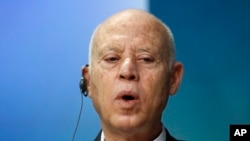
A Tunisian human rights defender was taken into custody after fighting for migrant rights and speaking against sentiments passed by President Kais Saied, an NGO and media reports said on Tuesday.
Speaking to French media outlet, Agence France-Presse, AFP, Tunisian Human Rights League chief Bassem Trifi said Saadia Mosbah, the head of the Mnemty association, was being "kept in custody for five days pending investigation."
Her arrest came as authorities waged a campaign against sub-Saharan migrants in Tunisia, expelling them from cities and other areas.
Local media reported that the police began investigating Mosbah, whose group combats racism and defends migrants' rights, on suspicion of financial crimes.
Residents of the southern town of El Amra demonstrated in favor of deporting migrants last weekend, saying the situation had become unbearable.
Mosbah was among those that spoke against a speech by President Kais Saied last year in which he denounced "hordes of illegal migrants" as a demographic threat.
Her arrest came just hours after Saied lashed out at organizations that defend the rights of sub-Saharan migrants in the country.
"The associations that cry today and shed tears in the media receive huge amounts of money from abroad," Saied said at a meeting on Monday of the national security council.
"Most of their leaders are traitors and mercenaries," he charged.
The authorities have raided several encampments in recent weeks, tearing down tents and expelling migrants.
The Tunisian Forum for Social and Economic Rights NGO said authorities in the nation’s capital, Tunis, on Friday cleared encampments and expelled hundreds of asylum seekers, migrants and refugees, before busing them west to near the border with Algeria.
The North African nation has been grappling with a severe migration crisis due to an influx of Sub-Saharan Africans seeking to migrate to Europe in boats. It has replaced Libya as the region’s main departure point for people fleeing poverty and conflict in Africa and the Middle East.
Information for this article was sourced from Reuters and Agence France-Presse.
Tunisian coast guard retrieves bodies of 14 migrants off Djerba coast

TUNIS, TUNISIA — The bodies of 14 migrants have been found in recent days off the coast of Tunisia's southern Djerba island, a public prosecutor in the city of Medenine told AFP Wednesday.
Fethi Bakkouche, prosecutor at the court in Medenine, said that "bodies began to appear near the coast of the island of Djerba since Friday."
"The toll reached 14 bodies," Bakkouche said, adding that they were of irregular migrants.
Most of them had come from sub-Saharan African countries, he said, and one was an Egyptian man identified by the passport he was carrying.
Tunisia as well as neighboring Libya have become key departure points for migrants, often from other countries, who risk perilous Mediterranean Sea journeys in the hopes of reaching Europe for better lives.
Some 2,498 people died or went missing while attempting to cross the central Mediterranean route in 2023, a 75-percent increase from the previous year, according to the UN's International Organization for Migration.
On Tuesday, Tunisian authorities in Sfax, southeast of the capital Tunis, said they found the bodies of 22 migrants who had also washed ashore over several days and seven other bodies off the coast of Gabes.
Some information in this report came from Reuters
Tunisia Detains Prominent Journalist Mohamed Boughalleb for Insulting Public Official

TUNIS — The Tunisia public prosecutor detained prominent journalist Mohamed Boughalleb on Friday on suspicion of insulting a public official, which the journalists union said was aimed at silencing the voices of journalists.
The detention of Boughalleb, who has been a critic of President Kais Saied, reinforces activists’ fears that the government was increasingly restricting freedoms ahead of presidential elections expected this year.
"A public sector employee insisted on filing a complaint against Boughalleb after he insulted her on social media and repeated it on a radio program,” Judge Mohamed Zitouna, spokesperson of the public prosecutor, told Reuters without naming the employee. The court will decide whether to extend or cancel his detention.
The police on Friday began questioning Boughalleb, an independent journalist, amid a broad campaign of support from journalists and activists who called on Saied to stop restricting freedom of speech.
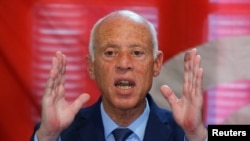
Saied seized extra powers in 2021 when he shut down the elected parliament and moved to rule by decree before assuming authority over the judiciary.
Since Tunisia's 2011 revolution, press freedom has been a key gain for Tunisians and its media has become one of the most open of any Arab state.
However, politicians, journalists and unions say that freedom of the press faces a serious threat under the rule of Saied, who came to power in 2019 in free elections and who has rejected such accusations, saying he will not become a dictator.
The National Syndicate of Tunisian Journalists demanded the immediate release of Boughalleb and expressed its readiness for all forms of struggle to defend free speech.
Tunisia, Libya Border Crossing Closed After Armed Clashes

TUNIS — Tunisia and Libya have closed a major border crossing at Ras Jdir due to armed clashes, Tunisian state TV and Libyan authorities said.
Libya's interior ministry said in a statement on Tuesday that "outlaws" had attacked the border, which sees a large flow of Libyans often going to Tunisia for medical treatment and trucks with goods coming in the opposite direction.
"This action carried out by these outlaw groups will not be tolerated, and legal measures and the most severe penalties will be taken against those involved," the Tripoli-based ministry said, without giving further details.
Libya has had little peace since a 2011 uprising and is split between eastern and western factions, with rival administrations governing each area.
Unverified footage on social media showed a burning vehicle at Ras Jdir and people running, with the sound of gunfire.
The ministry said on Sunday it had deployed security forces at the border to combat smuggling and insecurity.
Tunisia's Tataouine Radio said late on Monday that Tunisia closed the crossing for the safety of citizens going to Libya.
Tunisian Women Celebrated International Women’s Day
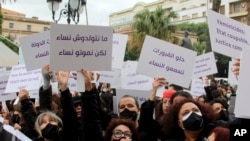
TUNIS — For many Tunisian women, it was a day for acknowledging what they have achieved for women’s rights so far. For others, it was an occasion to recognize and continue the fight against challenges that still exist today, creating gender inequality.
In 1956, immediately after independence from France, Tunisian President Habib Bourguiba granted women citizenship rights.
The Personal Status Code, or family law, also eliminated polygamy, introduced a legal age for women to marry, granted women guardianship of their children in the event of the father’s death, and made it possible for women to initiate divorce for the first time.
The government also created the National Union of Tunisian Women to implement the reforms.
In recent days, International Women’s Day has played prominently on social media sites in Tunisia; mentioning examples of many unique achievements in women equality.
Nour Bouqdida is one of a few women in Tunisia who cut men’s hair.
Speaking to VOA, Nour says she chose men's shaving because, since she was a little girl, she had been watching videos about this type of shaving, and little by little she fell in love with it and decided to learn it.
She says her family was open to this choice, and they helped her open her own salon.
She says she was subjected to a lot of criticism on social media, but that was a great motivation to continue this profession.
The 1990s ushered in a second wave of legal reforms. President Zine El-Abidine Ben Ali created the Women’s and Family Affairs Ministry, a post for an adviser to the president on women’s affairs, and the Center for Studies, Documentation and Information on Women.
In 1993, the state reformed the Nationality Code to allow Tunisian mothers to pass their citizenship to their children born to non-Tunisian fathers.
The role of women in Tunisian society was seen in a confrontation led by women after the Arab Spring uprising protests in 2011.
Women had a decisive role in overthrowing the Islamist Ennahda movement.
Rajaa Chebbi is the granddaughter of the Tunisian Arab poet Abu al-Qasim Chebbi, who rose to the upper ranks of the Tunisian Ministry of Interior.
"In 1991, I succeeded in a competition with the Ministry of the Interior to join the law enforcement forces, eventually becoming the first woman to be promoted to the rank of General Commissioner, 1st category, in Tunisia and the Arab world. This wasn't something I had planned, but I worked hard, doing the best I could," Chebbi said.
Some Tunisian men worked hard for women equality.
Imed Zouari works with the aid organization Oxfam in Tunisia and has focused closely on women’s issues.
"The Feminist Movement in Tunisia is continuing the fight. For decades we have been looking for equality, to change the path of policies, laws and the social norms towards achieving equality of rights and law. That is a long way, but it will continue and it will one day be ordered," Imed said.
He and other activists, however, say they are concerned that rights of Tunisian women have been eroded somewhat, including when the constitution was revised in 2022, removing some of the language on women’s equality. Also, women faced harassment at the polls in the country’s 2022 election.
Thousands in Tunisia Protest Economic Woes
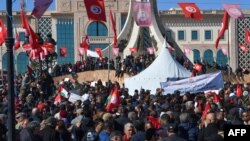
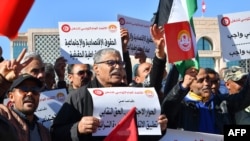
TUNIS, TUNISIA — Thousands protested deteriorating living standards outside Tunisia’s prime minister's office in Tunis on Saturday following a call from the country’s main trade union confederation.
"The economic and social situation continues to worsen," the confederation's head, Noureddine Taboubi, said in a speech to protesters.
Taboubi said the state's ability to service its foreign debt in 2023 had been "to the detriment of the people and resulted in shortages of basic products."
He criticized the implementation of "diktats from the International Monetary Fund" (IMF) at the expense of ordinary Tunisians.
The Tunisian economy is at a standstill with growth of 0.4 percent and an unemployment rate of 16.4 percent in 2023, according to the National Institute of Statistics.
Unemployment stood at 15.2 percent at the end of 2022.
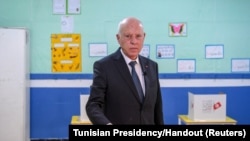
President Kais Saied has ruled by decree since a July 2021 power grab and last year rammed through a constitution that gave his office unlimited powers and neutered parliament.
Weathering a grave economic crisis, Tunis concluded an agreement with the IMF in October 2022 for a two billion dollar loan facility.
But loan tranches stalled when the president rejected reforms demanded by the Bretton Wood Institution.
Tunisia Slaps Opposition Figure With Six Months Jail Time, His Lawyer Says
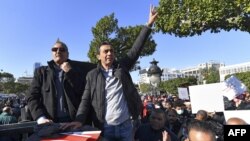
TUNIS — A Tunisian court has slapped a six-month prison term on opposition figure Jawhar Ben Mbarek over remarks criticizing the country's latest elections, his lawyer said Saturday. He’s been detained since February last year.
Ben Mbarek, co-founder of the National Salvation Front opposition alliance who is on hunger strike to protest his detention, was tried over his rebuke of legislative elections in 2022 which he had called a "ridiculous coup d'etat."
Held over "conspiracy against state security," Ben Mbarek remains behind bars as he awaits proceedings in other cases.
Tunisian and international rights groups have described the article under which Ben Mbarek was sentenced as a form of "repression" of free expression in the North African country, where President Kais Saied has ruled by decree since a 2021 power grab.
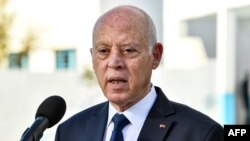
"Jawhar Ben Mbarek was sentenced without having the option to defend himself" due to his health condition after 13 days without food, his lawyer Ayachi Hammami told AFP.
Along with other figures detained since February 2023 over national security charges, Ben Mbarek has been on hunger strike to protest what he called the "arbitrary and unfounded" grounds for his arrest.
Ben Mbarek "was unable, due to the state of his health, to... be present at the hearing," the lawyer said, adding that the judge had proclaimed the verdict despite a request to postpone the proceedings.
Ayachi said the defense plans to appeal the ruling.
Ahmed Nejib Chebbi, another co-founder of the National Salvation Front, told AFP that Ben Mbarek "was sentenced to six months in prison for an opinion. I am truly outraged."
Rached Ghannouchi, the jailed leader of the Islamist-inspired Ennahdha party which is part of the opposition alliance, suspended his hunger strike on Wednesday for fear of health complications.
Rights groups have repeatedly condemned the proceedings against Tunisian opposition figures and called for their release.
Elected democratically in October 2019 with a five-year mandate, Saied launched a power grab in July 2021, dismissing the prime minister and suspending parliament.
He later pushed through sweeping changes to concentrate power in his office, shaking the foundations of the only democracy born out of the first Arab Spring uprisings in 2011.
Tunisia Farmer Switches to Old Wheat Varieties as Climate Change Bites
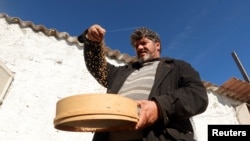
TUNIS — Tunisian wheat farmer Hasan Chetoui is seeking inspiration from the past as he tries to adapt to drought caused by climate change by sowing old wheat varieties he hopes will produce crops throughout the year.
Chetoui does not believe his experiment with alternative types of wheat is likely to work everywhere, but he thinks it may help him cope after years of scant rains and heatwaves that destroyed much of his crop last year.
"We obtain an old Tunisian type of wheat, cultivated in the field, capable of producing multiple times a season, providing us with strategic solutions," he said.
Chetoui's farm is located in the Borj Al-Amri area of northern Tunisia, a region that was a bread basket for Mediterranean civilisations stretching back to ancient Rome and Carthage, though Tunisia is now a net wheat importer.
Years of drought affecting much of North Africa have emptied Tunisian reservoirs and dried up crops, while a succession of scorching summers have seared some of those that remain.
Chetoui hopes that by avoiding reliance on a single summer harvest, he may be able to produce at least some wheat even in bad years. He and agricultural union officials said other farmers have resorted to traditional seeds, but had only anecdotal accounts of their experience.
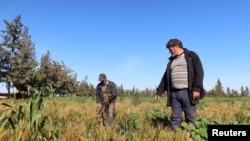
Agricultural experts in Tunisia are skeptical that old wheat varieties will succeed in protecting farmers from the impact of climate change, and point out that modern wheats produce far higher yields.
However, they also say older varieties may work better in certain areas or under specific conditions, and that Chetoui's experiments are worth under taking.
"We cannot determine whether they will succeed or fail because we cannot assess the effectiveness until it is implemented on a large scale," said Mohamed Rajaibia of the Tunisian Agricultural Union.
Chetoui began working on farms at the age of 12. Now 64, he still seeks seeds for old grain varieties including corn and barley as well as wheat, for use in his fields.
For years he has been sowing harvests with seeds that he says were used in his family for generations and were handed down to him by his father.
He has also used some old varieties from the Tunisian seed gene bank, he said, and has collected seeds from other farmers who said they were family inheritances including some that are not registered with the gene bank.
"We must rely on our original Tunisian seeds because, through experience and knowledge, these seeds hold the solution and can contribute to many strategic solutions in addressing food crises," he said.
Not all experts disagree with this notion.
"Original seeds are rooted in nature, rooted in the quality of the soil and rooted according to the location, and they have the ability to adapt," said Hussein al-Rhaili, an agriculture policy expert in Tunisia.
Tunisia Opposition Leader Goes on Hunger Strike
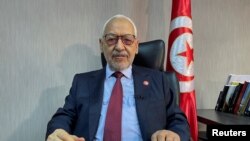
TUNIS — Imprisoned Tunisian opposition leader Rached Ghannouchi went on hunger strike on Monday in solidarity with other anti-government figures waging a protest fast to demand their immediate release, a team of opposition lawyers said.
Ghannouchi, 82, a fierce critic of President Kais Saied and head of the Ennahda main opposition party, was jailed last year on charges of incitement against police and plotting against state security.
Earlier this month in a separate case a judge sentenced him to three years in prison on charges of accepting external financing.
"While he is fighting the 'empty stomach' battle, Ghannouchi calls on Tunisians to adhere to a democratic Tunisia that includes everyone on the basis of freedom ... and the independence of the judiciary," the lawyers said in a statement.
The opposition says Saied's sudden shutting down of the elected parliament in 2021 and moves to rule by decree amounted to a coup.
Saied, who enshrined his new constitutional powers in a referendum with a low turnout in 2022, has denied his actions were a coup and said they were needed to save Tunisia from years of chaos.
Six opposition leaders arrested last year in a crackdown began an open-ended hunger strike last week to protest at their imprisonment without trial and demand their immediate release. They called for an end to judicial prosecutions against all politicians, journalists and civil society activists and for intimidation and threats to judges to stop.
The leaders — Jawher Ben Mbarak, Khayam Turki, Ghazi Chaouachi, Issam Chabbi, Abdelhamid Jalasi, and Rida Belhaj — were detained on suspicion of plotting against state security.
The opposition accuses Saied of muzzling the press and imposing authoritarian rule. They say his constitutional changes have pulled apart the democracy built after a 2011 revolution.
Saied rejects those accusations and has called his critics criminals, traitors and terrorists and warned that any judge who freed them would be considered abetting them.
Forum