



Madagascar
Cyclone Kills 11 in Madagascar, Officials Say
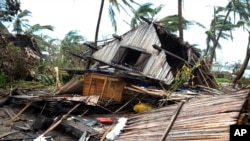
ANTANANARIVO, MADAGASCAR — A slow-moving cyclone that unexpectedly turned toward Madagascar has killed 11 people on the island nation as high winds ripped down trees and torrents of water rushed through villages, washing away houses, officials said.
Cyclone Gamane was projected to skim the island that sits in the Indian Ocean east of southern Africa but changed course and made landfall in the north on Wednesday, the BNGRC national disaster management office said on Thursday morning.
Six people have drowned, and five others were killed by collapsing houses or falling trees, authorities said.
Some 7,000 people on the island were affected by the storm, according to Madagascan authorities.
The cyclone moved slowly, amplifying its destructive effects. Video images showed torrents of water rushing through villages and people making human chains in waist-deep water trying to help those trapped in their houses escape the deluge. Numerous routes and bridges were flooded and cut off.
"It's rare to have a cyclone like this. Its movement is nearly stationary," General Elack Andriakaja, director general of the BNRGC, said, adding, "when the system stops in one place, it devastates all the infrastructure. And that has serious consequences for the population. And significant flooding."
Andriakaja said the low-pressure system was expected to "graze the northeast coast of Madagascar but it is a natural phenomenon and there was a change in trajectory."
The general also said Gamane "finally came to hit the Vohemar district" at 5:45 am on Wednesday.
Gamane has been re-classified as a tropical storm and was expected to leave the island on Friday afternoon, according to meteorologists.
Cyclone season in southwestern Indian Ocean normally lasts from November to April and sees around a dozen storms each year.
Madagascar's Rajoelina Begins New Term Amid Opposition Boycott
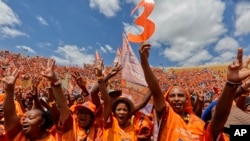
ANTANANARIVO, MADAGASCAR — President Andry Rajoelina took the oath in a packed stadium on Saturday to start a new term as Madagascar's leader, rebuffing an opposition boycott and international concerns over the island's future.
In front of six African presidents in the crowd of 50,000, the 49-year-old party organizer-turned-politician vowed to act with "integrity" to lift the country of 29 million out of its poverty.
"Madagascar is today under construction. The transformation is underway, rising on the horizon," he said before watching a military parade.
But the absence of two former presidents, Marc Ravalomanana and Hery Rajaonarimampianina, who attended Rajoelina's last inauguration in 2018, highlighted early tensions facing the new administration.
They are part of an opposition coalition that held near-daily protests for weeks before the November 16 vote to denounce what they called a "constitutional coup d'etat" by the president to stay in office.
Demonstrations were banned in the capital, Antananarivo, for five days ahead of Saturday's ceremony.
Most opposition candidates boycotted the election and the coalition has insisted it will not recognize the result. Rajoelina secured victory without needing a second-round vote, though only 46% of eligible voters cast ballots.
Rajoelina, who became president a first time without an election in 2009 after Ravalomanana was ousted in a military mutiny, has quickly faced international pressure.
'Reforms' needed
After the election, ambassadors from the European Union, United States and other major donor countries expressed concern at "tensions and incidents" that marked the campaign.
The U.S. State Department said that "domestic and international election observers, noted irregularities in the electoral process."
Western nations said in a joint statement that Rajoelina must "take steps to restore confidence conducive to dialogue" and carry out legal and electoral reforms ahead of future votes.
The economy is in crisis and Rajoelina has said he will devote his new term to boosting the livelihoods in what is one of the world's poorest countries, despite its natural wealth.
The resource-rich island country is the world's biggest producer of vanilla but a price fall amid sluggish world demand has hit the industry and Madagascar's balance of payments.
About 75% of the population live below the poverty level.
The president has visited poor parts of the capital in recent days handing out solar lamps in areas that have no electricity.
His party has condemned the opposition as "irresponsible" though Rajoelina has said he will work with "constructive" elements.
Some opposition activists have faced criminal charges for taking part in the demonstrations before the election that were often broken up with tear gas.
Ahead of the inauguration, Rina Randriamasinoro, secretary general of the TIM opposition party, was jailed for two years for taking part in a banned demonstration.
Madagascar Constitutional Court Declares Rajoelina Winner of Presidential Vote
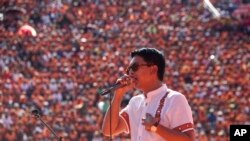
Madagascar's incumbent President Andry Rajoelina was declared the winner on Friday of last month's election by the country's High Constitutional Court, which handed him a third term after dismissing various challenges to provisional results.
"Andry Rajoelina is elected as the president of the republic of Madagascar and is taking his functions as soon as the swearing (in is conducted)," said court head Florent Rakotoarisoa. He received 58.96% of the votes cast, the court said.
The challenges to the electoral body's provisional count that were dismissed included one from the runner-up, lawmaker Siteny Randrianasoloniaiko. He got 14.39% of the vote, according to the court.
Ten out of 13 candidates boycotted the poll but their names were already on the ballot, leaving them to share the rest of the votes cast.
"The election took place peacefully, and it is proof that democracy in Madagascar and the Malagasy people have reached political maturity," Rajoelina told journalists outside the courtroom.
"There will be some changes but you don't change a winning team either," he said.
The Nov. 16 election was preceded by weeks of protests, with the opposition accusing Rajoelina of having created unfair election conditions, and the turn-out was less than 50%.
Rajoelina has dismissed allegations the vote was unfair and the army has warned against attempts to destabilise the country.
Nine foreign embassies, including the United States, United Kingdom and European Union, issued a joint statement "noting" the final results.
"In view of the tensions and incidents that characterised the electoral process, and the tense political context, it is now up to the newly-elected head of state, together with all the country's stakeholders, to take steps to restore confidence conducive to dialogue," the embassies said.
The opposition has said the 46.35% voter turn-out in the election was the lowest in the country's history.
Hajo Andrianainarivelo, a former minister among the candidates who boycotted the poll, has vowed to fight against what he said was a lack of respect for the laws of the land, and oppression of the people.
"The popular fight begins now," he said on Thursday.
Rajoelina, 49, first came to power in a 2009 coup. He stepped down in 2014 as leader of a transitional authority but then became president again after winning a 2018 election.
Madagascar's President Rajoelina Reelected in Boycotted Poll
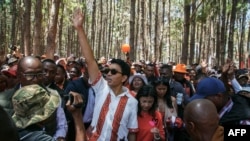
ANTANANARIVO — President Andry Rajoelina has been reelected in the first round of a ballot boycotted by nearly all opposition candidates in the Indian Ocean island nation, the election commission said Saturday.
Rajoelina won 58.95% of the votes cast in the November 16 presidential election, according to the results presented by the poll body which need to be validated by the Constitutional Court.
Turnout was just over 46%, down on the previous presidential election in 2018, which the election commission blamed on "ambient political climate" and "manipulation of opinion."
"The Malagasy people have chosen the path of continuity and stability," the 49-year-old Rajoelina said after the results were announced.
Rajoelina first came to power in 2009 following a mutiny that ousted former President Marc Ravalomanana. He then skipped the following elections only to make a winning comeback in 2018.
The 11 million voters had to choose between Rajoelina and 12 other candidates. Ten of the incumbent's rivals refused to campaign and urged voters to shun the ballot, branding it a farce.
Rajoelina, a former mayor of the capital Antananarivo, is accused by rivals of corruption, greed and turning a blind eye to the pillage of the country's natural resources, including its precious rosewood forests. Rajoelina has denied corruption claims.
"What results? What election?" was the joint opposition response to an AFP request for comment on Rajoelina's victory.
"We will not recognize the results of this illegitimate election, riddled with irregularities, and we decline all responsibility for the political and social instability that could ensue," the opponents warned.
The opposition has not yet indicated if it will formally contest the result and has not called for more street demonstrations.
In the weeks leading up to the vote, the opposition — including two former presidents — led near-daily, largely unauthorized protests that were regularly dispersed by police using tear gas.
Madagascar has been in turmoil since media reports in June revealed Rajoelina had acquired French nationality in 2014.
Under local law, the president should have lost his Madagascan nationality, and with it, the ability to lead the country, his opponents said.
Opposition candidates complained of an "institutional coup" in favor of the incumbent, accusing government of working to reappoint Rajoelina.
They called for the electoral process to be suspended and for the international community to intervene.
Eight countries and organizations including the European Union and the United States expressed concern about the "disproportionate use of force" to disperse opposition demonstrations.
The opposition has denounced irregularities, including closed polling stations, a lack of ballot boxes and the use of state resources by Rajoelina for his campaign.
One of the two opponents who formally remained in the race, Siteny Randrianasoloniaiko, also denounced "worrying anomalies" which he said "raise legitimate questions about the validity of the results."
The election took place "in regular and transparent conditions," Arsene Dama, the president of the national electoral commission, said on Saturday.
Dama's impartiality has been questioned by the opposition.
Preliminary Election Results Show Madagascar's President in Early Lead

ANTANANARIVO — Madagascar's President Andry Rajoelina took a predictably commanding early lead on Friday in his bid for re-election in a vote marked by low turnout and an opposition boycott, preliminary results showed.
The 49-year-old entrepreneur and former DJ rose to power on the Indian Ocean island in a 2009 coup, stepped down after almost five years as leader of a transitional authority, then won a 2018 election.
The opposition says he should not have run again in Thursday's poll because he acquired French nationality in 2014 — which they say automatically revokes his Malagasy one — and has created unfair election conditions.
He says both accusations are baseless political tactics.
In preliminary results from the electoral commission CENI, Rajoelina had garnered more than 72.9% of the estimated total of 6.2% counted so far.
Votes counted so far indicated a turnout of 39.5%, compared to 55% in the equivalent first round of voting in 2018.
'Enthusiasm not there'
There were 11 million people out of a population of roughly 30 million registered to vote in this year's polls, which were preceded by weeks of opposition-led protests.

Of 12 opposition candidates originally, only two took part in the vote. One was Marc Ravalomanana, the former president ousted in 2009, the other Siteny Randrianasoloniaiko.
"Enthusiasm was not there," said Andriamanambe Raoto, editor-in-chief of Politika, a monthly publication.
The United States voiced concern on Thursday over low turnout, inadequate training for election staff and irregularities by party officials.
The opposition said participation was the lowest in Madagascar's history and vowed to keep protesting.
Rajoelina says the constitution does not require the head of state to exclusively hold Malagasy nationality, and that any loss of nationality is subject to signed authorization by the government.
The opposition also called for changes to the makeup of electoral commission and for the formation of a special court to hear election disputes.
Regional observer groups did not respond to requests for comment on the early results. Full provisional results are expected on November 24 while the High Constitutional Court is due to certify them on November 30.
Madagascar Votes in Presidential Elections, Others Boycott
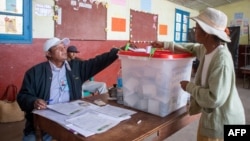
ANTANANARIVO, MADAGASCAR — Madagascar's President Andry Rajoelina urged people to vote on Thursday in a highly contested presidential election in which he is seeking a new term, and slammed an opposition call to boycott the polls.
Rajoelina is one of 13 candidates on the ballot but 10 of the others have called on voters to shun the elections, complaining of an "institutional coup" in favor of the incumbent.
Following a night-time curfew and weeks of protests, voting got calmly under way early Thursday, with voters emerging from rudimentary polling centers, their thumbs stained with green and gold indelible ink.
Polls are scheduled to stay open until 05:00 pm (1400 GMT).
The incumbent president has brushed off criticism and expressed confidence that he will secure re-election in the first round of voting.
After casting his ballot in the capital, Antananarivo, Thursday, Rajoelina urged voters to do the same.
"The only democratic path... are elections," he said, denouncing people "who try to cause trouble."
Eugene Rakatomalala, a 43-year-old voter said, "I'm voting, but we know this isn't normal."
"There weren't any candidates who did campaigns," the voter added.
Roland Ratsiraka, one of the protesting candidates, on Tuesday said, "we do not want to participate in this fraud, it is a joke on Madagascar."
Since early October, the opposition leaders have led near-daily, largely unauthorized protest marches in the capital. They have been regularly dispersed by police firing tear gas.
While the opposition refused to campaign, Rajoelina flew across the country by private plane, showcasing schools, roads and hospitals built during his tenure.
Lalatiana Rakotondrazafy, Rajoelina's campaign spokesperson said, "it is irresponsible to encourage voters not to vote."
Alain Randriamandimby, a T-shirt printer in Madagascar said "we don't want any more demonstrations, we don't want any more problems in the country. We want to choose for ourselves, by voting."
At a news stand on Wednesday, residents looked concerned as they scanned newspaper headlines.
Chrishani Andrianono, a 55-year-old Madagascan said, "people have become aware of the dictatorship we live under," complaining that after 11 years in power, the incumbent president had little to show for it.
"We do not see what he did for us," Andrianono added.
Josiane Rasomalala, a 41-year-old from Madagascar supported Andrianono's sentiments.
"In the morning, I don't eat — only a little at lunchtime and in the evening. Otherwise, I can't get by, I don't have enough," Rasomalala, said, adding, "I'm voting because we need a better life."
Authorities in Madagascar imposed a night-time curfew on Wednesday in Antananarivo, following what police said were "various acts of sabotage."
The local police prefect later said an investigation had been opened after electoral material stored at three polling stations was burned on Tuesday.
Madagascar has been in turmoil since media reports in June revealed Rajoelina had acquired French nationality in 2014.
Under local law, the president should have lost his Madagascan nationality, and with it, the ability to lead the country, his opponents said.
Rajoelina has denied trying to conceal his naturalization, saying he became French to allow his children to pursue their studies abroad.
His challengers were further enraged by another ruling allowing for an ally of the president to take over the reins of the nation on an interim basis after Rajoelina resigned in line with the constitution to run for re-election.
They have also complained about electoral irregularities.
The head of the electoral commission, who critics accuse of favoring the president, on Thursday said some voters did not receive their electoral cards on time.
This was "either because we did not have the correct address, or because they were not at home during the distribution," said Arsene Andrianarisedo.
The opposition grouping has vowed to continue protesting until a fair election is held.
Eleven million people registered to vote in Madagascar's 2023 elections.
The Southern African Development Community, SADC, a regional bloc, as well as the African Union and the European Union, have sent observer missions to monitor the vote.
Madagascar's President Rajoelina Expects Victory, Says 'I'm Going to Win'
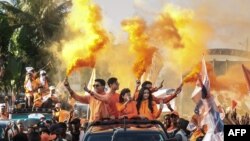
TOAMASINA, MADAGASCAR — Madagascar's outgoing president Andry Rajoelina expressed little doubt as he spoke to AFP about his predictions for the country's upcoming elections.
"I'm going to win, that's for sure, and in the first round," said the leader, who will seek re-election on Thursday and is banking on popular support and God to get him over the line.
Voters in the Indian Ocean island nation will elect a president on November 16, but the run-up to the poll has been marred by near daily opposition demonstrations after disputes over its regularity.
Rajoelina, 49, became Africa's youngest head of state in 2009 when he took power on the back of a coup.
After not running in the 2013 election due to international pressure, he was voted back into power in 2018 and has since held the reins in a country that remains among the poorest in the world despite vast natural resources.
"My support is the people. Then my wife. And first of all, God, who guides me and protects me," Rajoelina told AFP on Saturday night, visibly drained after several hours of campaigning.
Earlier in the day, thousands had turned out to cheer him on in the eastern city of Toamasina, Madagascar's economic hub and largest port. It was the outgoing president's last visit before the first round vote.
While the island's second-largest city is accessible by road from the capital Antananarivo, dilapidated infrastructure hampers the journey.
Rajoelina arrived swiftly via private plane, with little time to see whether the opposition had staged one of their regular protests against him.
"The opposition wants chaos and to take the population into the streets, but they can't do it because the population supports me," Rajoelina said.
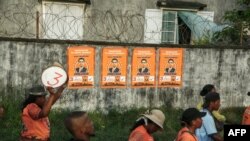
"Madagascar doesn't need another crisis," he added.
Several hundred people, mostly youths, gathered in the centre of Antananarivo on Saturday in protest at what the opposition calls an "institutional coup" to favour the sitting president.
'This is America'
In Toamasina, crowds on foot, motorbike and tuk-tuks waited for several hours to catch a glimpse of Rajoelina.
A sound system mounted on the back of a pick-up truck played a campaign anthem to the crowd.
"There are people who walk for several hours" to attend the rallies, Rajoelina said.
"It's the love, conviction and hope that people put in me" that makes them come, he added, insisting that the only payment he offered the attendees was a Rajoelina T-shirt.
A few dozen meters from the beachside stage is a vast $9.5-million coastal development nearing completion called "Miami," featuring restaurants, a basketball court, a skatepark and gardens.
"This is Miami, this is America," a passer-by joked to AFP.
The development is a glaring juxtaposition in a country where three-quarters of the population live below the poverty line.
Rajoelina said he had spent the last five years doing "everything to make up for Madagascar's lagging development."
Ahead of this week's election, he has made electricity provision a campaign pledge, as only 30 percent of the island's households are currently connected.
Madagascar's Parliamentary Chief Calls for Suspension of Presidential Elections
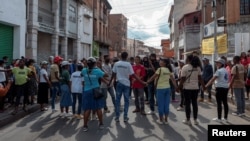
ANTANANARIVO — The head of Madagascar's lower house of parliament on Thursday called for the suspension of next week's presidential elections, after weeks of regular opposition rallies.
Christine Razanamahasoa, who leads a mediation group to find a way out of a political crisis that has raged for weeks, said the current situation in the country did not allow for a free and credible vote to be held on November 16.
The mediation group "strongly demands that authorities suspend the presidential election scheduled for November 16," Razanamahasoa told a press conference in Antananarivo.
She said this was to ensure "peace" and "harmony" in the country, where political tensions have been running high in the run-up to the vote, which was already postponed by a week.
But a spokeswoman for Madagascar's outgoing president Andry Rajoelina called the request a "far-fetched idea."
"There's no reason why the elections shouldn't be held on November 16," Lalatiana Rakotondrazafy told AFP.
The country's laws do not provide for the "suspension" of a vote and any such decision would require government approval.
The Indian Ocean island nation has been shaken by a fierce battle between President Andry Rajoelina, who is running for re-election, and most opposition leaders.
Eleven out of 13 opposition candidates have led near daily, unauthorized marches in Antananarivo, for more than a month, protesting at what they have called an "institutional coup" that favors the incumbent.
The demonstrations have been regularly met by a strong police presence.
Numerous people were injured on Wednesday as police dispersed yet another protest.
Earlier this week, a presidential candidate was detained at another rally.
The European Union, the United States and other members of the international community signed a joint statement on Thursday expressing their "deep concern following the violent incidents of recent days."
They had previously said they were following the preparations for the elections with "the utmost vigilance" and denounced the excessive use of force against the opposition.
The statement urged "all parties involved to exercise the utmost restraint, engage in peaceful dialogue and show a sense of responsibility."
Some 60 Madagascan civil society organizations and trade unions have called for the "cancellation" of the first round vote, warning of an "even harder crisis" if the election were to go ahead.
Voters in Madagascar were initially due to head to the polls on November 9, but the top court in October ordered that elections be postponed after another presidential candidate was injured during a demonstration.
The date for a potential second round on December 20 was kept unchanged.
Madagascar Police Disperse Protest, Briefly Detain Presidential Candidate
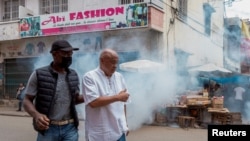
ANTANANARIVO — A fresh protest by supporters of Madagascar's opposition was dispersed on Monday, and one of its candidates for an upcoming presidential election briefly detained, police said.
On Saturday when police used tear gas to prevent a rally going ahead in the capital Antananarivo. On Monday a small group of protesters tried once more to reach a highly symbolic central square.
Police were, however, posted around the city centre, an AFP journalist saw.
Jean Jacques Ratsietison, a 60-year-old economist and candidate in the November 16 presidential election, was detained, several journalists at the scene said.
Ratsietison, who was released in the evening, later told national television that accusations against him, including committing acts of violence and attempting a coup d'etat, were disproportionate.
For weeks, the Indian Ocean island nation has been shaken by a fierce battle between President Andry Rajoelina, who is running for re-election, and several opposition leaders.
Opposition candidates have led near daily, unauthorised marches in Antananarivo, for more than a month, protesting at what they have call an "institutional coup" to favor the incumbent.
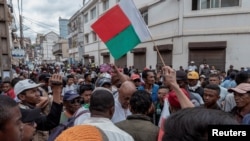
The general staff — encompassing the police, gendarmerie and army — told reporters on Monday it would ensure the protection of all 13 presidential candidates and their families.
"We heard rumors of planned attacks against certain candidates," a spokesman said, adding that the proposed protection did not extend to political meetings or demonstrations.
Another opposition candidate Roland Ratsiraka fumed that detention was "not a solution."
He said a legal complaint had been lodged against the local authority's decision to ban demonstrations at May 13 Square.
Another candidate Auguste Paraina also hit out at the police intervention on the streets as a "dictatorship."
"We're not going to stop, we are not afraid!" he told AFP.
Forum