



Benin
Benin Offers 2,000 ‘Personnel’ to Kenya-Led Haiti Force, US Ambassador Says
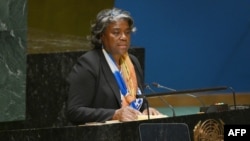
Benin has offered 2,000 “personnel” to support a planned Kenyan-led international force to help Haitian national police fight armed gangs, U.S. Ambassador to the United Nations Linda Thomas-Greenfield told a press conference on Monday.
The United Nations authorized the mission in October, a year after Haiti's unelected government requested it. The U.N. estimates the conflict in the Caribbean nation killed close to 5,000 people last year and has driven some 300,000 from their homes.
Thomas-Greenfield, speaking in Guyana where she traveled to lead the U.S. delegation to the Caribbean Community, CARICOM summit there, said she had learned just before starting the trip that Benin had offered to support the force.
The U.S. ambassador said some Caribbean countries that had pledged support had called for more Francophone nations to join the effort.
A U.S. statement issued on the sidelines of the G20 summit in Rio de Janeiro last week had announced "financial, personnel, and in-kind commitments to the mission" from Benin, France and Canada, the latter which later announced nearly $60 million for the mission.
The United States has itself committed $200 million and pledged to boost efforts to stem the flow of illicit arms to the Caribbean region. The U.N. estimates firearms held by Haitian gangs are largely smuggled from the United States.
Thomas-Greenfield said Guyana had also pledged funds to the mission, though she did not give an amount.
Kenya, which has pledged to lead the mission, offered 1,000 police officers, but a local court later barred the move as unconstitutional. President William Ruto has, however, said the plan will go ahead and meetings have since continued.
So far public offers to support the security force, which is based on voluntary contributions, have come largely from developing nations in Africa and the Caribbean.
Thomas-Greenfield said she had held meetings with Haitian Prime Minister Ariel Henry and encouraged both him and opposition groups to agree on a path forward, noting that no time frame has been set for the country's long-awaited elections.
Henry, who came to power after the assassination of the country’s last president in 2021, had pledged to step down by early February, but later said security must first be re-established in order to ensure free and fair elections.
Benin Receives First Doses of Malaria Vaccine
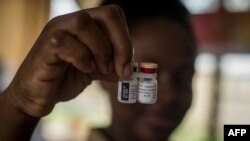
COTONOU, BENIN — Officials in Benin late on Monday announced that the nation received its first doses of a vaccine for malaria, the leading cause of infant mortality in the country.
Speaking to reporters at Cotonou airport, where the government officially received 215,900 doses of the RTS,S vaccine, Benin’s Health Minister Benjamin Hounkpatin said, "Malaria remains endemic and represents the leading cause of death among children under five years of age in Benin."
The first vaccinations will take place "within a few months", he added.
40% of outpatient consultations and 25% of hospital admissions in the West African nation are linked to malaria, according to the minister.
The vaccine will immunize "around 200,000 children" under the age of two, Faustin Yao, an immunization specialist at the UNICEF office in Benin, told AFP.
Yao said infants would receive four doses, at the age of six months, seven months, nine months and 18 months.
Benin is the third African country to receive doses of the vaccine after Cameroon and Sierra Leone, following a pilot phase in Ghana, Kenya and Malawi coordinated by the World Health Organization and funded by the GAVI Vaccine Alliance among others.
More than two million children have been vaccinated in these three African countries, leading to a "spectacular decline" in mortality and a significant drop in severe forms of malaria and hospitalizations, GAVI said.
According to the WHO, almost every minute, a child under the age of five dies from malaria.
Caused by a parasite transmitted by certain types of mosquitoes, the disease remains a formidable problem due in particular to its increasing resistance to treatment.
In 2021, 247 million cases were recorded across the world and 619,000 patients died, according to the WHO, which says the disease mainly affects Africa.
Africa accounts for 95% of Malaria cases and 96% of the deaths worldwide.
Benin Introduces Military Medals Amid Ongoing Jihadist Fight
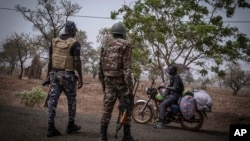
COTONOU, BENIN — Beninese authorities have introduced two new military medals to reward soldiers as the army grapples with a mounting jihadist threat on the country's northern border.
The move reflects Benin's struggle with spillover from conflicts in the Sahel where militants linked to the Islamic State group and al-Qaida have stepped up attacks as they seek to move south.
In a statement on Wednesday, the West African government said the National Defence Medal and the Combatant's Cross would "recognize personnel whose feats of arms deserve to be held up as an example or encouraged."
The Combatant's Cross is for soldiers killed or wounded fighting.
Political scientist and security specialist Odilon Koukoubou said the medals were designed to encourage and boost morale of Benin's security forces who have not experienced war since 1960 independence.
"The army has not been heavily called on at the front for national defense against an external enemy," he said.
"The situation is changing now with the emergence of the terrorist threat on the country's northern borders," Koukoubou added.
Authorities rarely comment on jihadist attacks in northern Benin, which borders Burkina Faso and Niger.
Beninese forces in April said they had faced around 20 incursions from across the frontier since 2021.
France's military withdrawal in the Sahel has heightened concerns about security along the borders of Benin and Gulf of Guinea neighbors Ghana, Togo and Ivory Coast.
Benin's government took measures to support its troops after it passed a law last week to provide for the dependents of killed or missing soldiers. Earlier this year the West African nation launched a recruitment drive for 5,000 additional troops to help reinforce the border.
Benin Battles to Protect Coastal Communities from Erosion
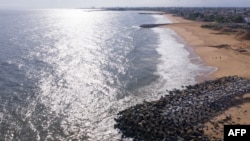
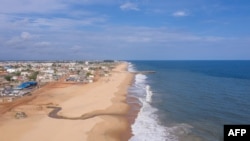
COTONOU — Along its Atlantic coast, Benin's government has spent millions of dollars to protect coastal communities from sea erosion. But Doris Alapini can only watch as waves tirelessly eat away at her land and the large seaside restaurant she built.
"The sea is advancing a lot. We have to do dredging or else block it, otherwise it will keep advancing," Alapini said as she walked along Cotonou's long sandy beach.
"I have seen how many times it has destroyed and invaded the neighborhood."
She has lived for 27 years in the Jak district, one of the oldest and most chic in the economic capital of Benin. Every year, sea waters overflow into her area.
"The neighborhood is under threat every day," she said.
"No one here has any guarantees. If there is a big wave, it will demolish the entire neighborhood."
Not all coastal erosion is linked to climate change. But since 2002, Benin has lost kilometers of coastline, said Esquill Outiclissou, executive of the government's general directorate of environment and climate.
"The state has not remained idle," he said, pointing to protective structures, stone groynes and other installations, particularly to the east of Cotonou.
According to Outiclissou, nearly 100 billion CFA francs ($160 million) have been injected into the protection of Beninese coasts in recent years and the investment helped slow down the ocean's advance.
Africa often finds itself on the front line of climate change impact despite the continent contributing the least to greenhouse gas emissions globally.
Still, Benin and its littoral West African neighbors Togo and Ghana are, just like Pacific islands and coastal South Asian cities, at risk of shore erosion's impact on communities.
With global warming affecting sea levels, coastal erosion will be one of the subjects leaders will address when they meet for COP28 in Dubai in December.
Race against time
Raymond Mekpe, a 40-year-old fisherman, cannot believe the erosion losses.
Born in Cotonou, Mekpe might not be a climate expert but has his own indicators to illustrate the sea's unbridled advance.
"The homes of my grandparents and my parents were there," he said, pointing out to sea. "We played somewhere there in our childhood," he added, gesturing towards another area where big waves crash.
Benin loses approximately 30 meters of its coastline every year, according to oceanographer Cossi Georges Degbe.
"It's really serious. And if nothing is done, within a few years we will lose the Cotonou Porto-Novo interstate road," the 51-year-old warned, referring to the main coastal route to the capital city.
"When we put protective structures in a given place, we are just moving the phenomenon along," he said.
For Outiclissou, the government must respond segment by segment, but "the segments that are still vulnerable are under study and will be dealt with in due course."
Thirteen structures have been built east of Cotonou starting from the coastal lagoon, he said.
Since then, the waves of erosion have become noticeably weaker, he added.
As well as rising water levels, due to climate change, extreme weather phenomena are increasing, "with very high waves washing over our coasts," explained oceanographer Degbe.
Alain Tossounon, president of a network of media focusing on water, the climate and environment, agrees more needs to be done.
"Efforts have not been sufficient and populations have not yet become aware of the importance of this phenomenon in the years to come," he said.
'Sea advances, destroys'
With Benin not the only country concerned, joining forces with neighbours could bring more results.
"We must consider a regional approach to slow down the advance of the waves," Tossounon said.
Benin and Togo have already started working together — a protective groyne of 18 kilometers (11 miles) in Togo and 24 kilometers in Benin made it possible to slow the waves in the fishing villages of Hillacondji and Aneho.
But despite these actions, seaside restaurant owner Alapini cannot help but feel angry.
"When we have populations who live by the sea, we have to have forecasts for them, a line in the state budget," she said.
"I'm shocked. By the time it takes to get funding, the sea is moving forward and destroying things."
Forum