



Burkina Faso
Journalists from Ukraine, Burkina Faso recognized for work


Ukrainian journalist Nataliya Gumenyuk was among the first people to investigate Russia’s abduction of children from Ukraine. At a ceremony in Washington, she was honored for her work, alongside journalists from Burkina Faso, Gaza, India and Belgium. From Washington, Liam Scott has the story.
Morocco pushes to bring Central Sahel ‘out of isolation’
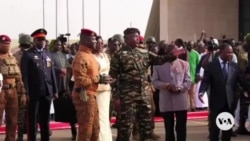
In a November interview, Morocco's foreign minister said his country plans to bring Central Sahel countries such as Burkina Faso, Niger and Mali "out of isolation" with a joint development and port access package known as The Atlantic Initiative. As they battle militants linked to terror groups, Central Sahel countries have turned away from regional and international partners, so what can their neighbors do to reach out to them? Henry Wilkins reports.
Sahel juntas write to UN over alleged Ukraine rebel support
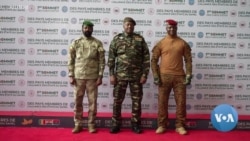
Burkina Faso, Mali and Niger have urged the U.N. Security Council to "take responsibility" for Ukraine's alleged support of rebels, following an attack in July in which Malian soldiers and mercenaries from Russia's Wagner group were killed. Reuters’ David Doyle has more.
Burkina Faso army condemns videos of corpses being mutilated
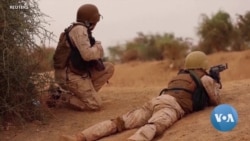
Videos have emerged on social media showing people who present themselves as troops from Burkina Faso committing "macabre acts" that have been condemned by the nation’s army as "rare cruelty". Reuters’ David Doyle has more.
Burkinabe mechanic transforms ordinary cars into limousine

In his garage in Ouagadougou, Burkina Faso, mechanic Sao Ouedraogo spends hours fixing, customizing, and transforming automobiles. His latest achievement: was turning an ordinary car into a limousine. VOA’s Gildas Da shares the story of this car enthusiast from the capital.
Refugees in Burkina Faso take up entrepreneurship to avoid relying on charity
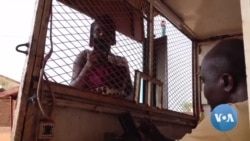
Burkina Faso is home to a large number of Internally Displaced People, IDPs, due to eight years of insecurity. They live in various towns across the country. But in the capital Ouagadougou, some are now trying to adapt by taking up jobs or starting businesses instead of depending on charity. VOA’s Gildas Da met with some of the IDPs and has this report.
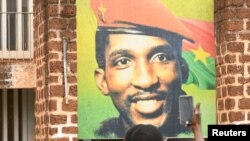
Burkinabe military rulers announce consultations for transition to civilian rule
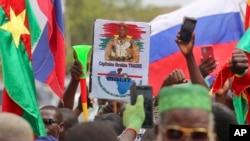
OUAGADOUGOU, BURKINA FASO — Burkina Faso’s military rulers have announced they will hold national consultations at the end of this month to determine the next steps in the nation’s transition to civilian rule.
Burkina Faso has been run by a military regime since mutinying soldiers deposed elected president Roch Marc Christian Kabore in 2022. Junta leader Captain Ibrahim Traore then seized power in another coup on September 30, 2022.
Traore established a transitional government and legislative assembly for 21 months, a period set to expire on July 1.
"National meetings have been called for May 25 and 26 in Ouagadougou," according to a press release signed by Minister of Territorial Administration Emile Zerbo and read on national television.
"These meetings will enable representatives of the nation's active forces to deliberate on the next steps to be taken in the transition, which will run until July 1, 2024, as stipulated in the October 14, 2022 charter," the announcement said.
The meetings will bring together representatives from civil society, political parties and the military to "take stock of the past months ... decide whether to continue the transition and what that continuation will be," according to the minister's statement.
Last month, all 71 members of the legislative assembly for transition, ALT approved a plan for a transition forum, leaving "it to the sovereign people who will meet during the national forum to decide the development of the transition."
Since 2015, Burkinabe forces have been struggling to combat jihadist insurgencies that have killed thousands of people and forced around two million from their homes — violence that army leaders used to justify their coups.
Traore initially promised a return to civilian rule with elections in 2024 but has since insisted that national security would take precedence over any vote.
An international NGO helps people in Mali and Burkina Faso to become economically successful
Burkina Faso suspends radio broadcasts on World Press Freedom Day

Statement on Burkina Faso's actions against VOA programming

Voice of America is concerned about restrictions on its content demanded by the government of Burkina Faso. The April 25, 2024 order seeks to suspend VOA French and Bambara language broadcasts for two weeks, reduce access to VOA’s website and digital platforms, and censor VOA coverage related to allegations of human rights abuses by the Burkinabè army against civilians.
“VOA stands by its reporting about Burkina Faso and intends to continue to fully and fairly cover events in that country,” said Acting VOA Director John Lippman. He added, “The Voice of America strictly adheres to the principles of accurate, balanced and comprehensive journalism, therefore, we ask the government of Burkina Faso to reconsider this troubling decision.”
Lippman remarked, “As the world prepares to observe World Press Freedom Day one week from today, this latest action to restrict the free flow of news and information is yet another example of the truth behind VOA’s motto: A Free Press Matters.”
Based on 2020 data, VOA's weekly reach in Burkina Faso is 14.3 percent.
HRW: Burkina Faso army killed 223 villagers in revenge attacks
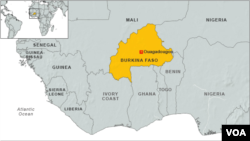
ABIDJAN, IVORY COAST — Soldiers in Burkina Faso's jihadist-hit north killed at least 223 villagers, including 56 children, in two attacks on February 25, Human Rights Watch said in a report on Thursday.
Burkinabe officials contacted by AFP did not comment on the allegation, which the New York-based group described as "among the worst army abuse in Burkina Faso since 2015."
"These mass killings ... appear to be part of a widespread military campaign against civilians accused of collaborating with Islamist armed groups, and may amount to crimes against humanity."
It said: "Soldiers killed 44 people, including 20 children, in Nondin village, and 179 people, including 36 children, in the nearby Soro village, of Thiou district in the northern Yatenga province."
The West African nation has been battered by a jihadist insurgency that swept in from neighboring Mali in 2015.
Thousands of civilians, troops and police have been killed, two million people have fled their homes and anger within the military at the mounting toll sparked two coups in 2022.
"The massacres in Nondin and Soro villages are just the latest mass killings of civilians by the Burkina Faso military in their counterinsurgency operations," said Tirana Hassan, executive director of Human Rights Watch.
"The repeated failure of the Burkinabe authorities to prevent and investigate such atrocities underlines why international assistance is critical to support a credible investigation into possible crimes against humanity," Hassan said.
HRW said it had interviewed 23 people, including 14 witnesses to the killings, three local civil society activists, and three members of international organizations.
"Human Rights Watch verified videos and photographs shared by survivors of the aftermath of the killings and injured survivors," it said.
Mass graves
On February 24 and 25, Islamist armed groups carried out several attacks on military targets, including barracks and bases, and on civilian infrastructure, such as religious sites, killing scores of civilians, soldiers and militia members.
Burkinabe Defense Minister Mahamoudou Sana on February 26 denounced "simultaneous and coordinated" attacks by Islamist fighters but made no mention of the mass killings of civilians in Nondin and Soro.
On March 1, Aly Benjamin Coulibaly, prosecutor of the high court Ouahigouya, the capital of Yatenga province, said he had received reports of "massive deadly attacks" on the villages of Komsilga, Nodin and Soro in Yatenga province with a provisional toll of "around 170 people executed" and others injured, and that he ordered an investigation.
Coulibaly said villagers had recounted that "military forces first stopped in Nondin, then in Soro, five kilometers (three miles) away."
"They believe that the killings were perpetrated in retaliation for an attack by Islamist fighters against a Burkinabe military and militia camp outside ... Ouahigouya, about 25 kilometers from Nondin, earlier that day," he said.
"Before the soldiers started shooting at us, they accused us of being complicit with the jihadists," a male survivor from Soro who was shot in the leg said.
"They said we do not cooperate with them (the army) because we did not inform them about the jihadists’ movements."
Witnesses said that survivors and people from nearby villages buried the bodies in Nondin in three mass graves.
Burkina Faso Mosque, Church Attacks Kills Dozens

OUAGADOUGOU — An attack on a mosque in eastern Burkina Faso has killed dozens of Muslims on the same day as another deadly attack on Catholics attending mass, local and security sources said.
The two attacks struck on Sunday in different regions of the junta-ruled country caught for several years in a spiral of jihadist violence.
"Armed individuals attacked a mosque in Natiaboani on Sunday around 5:00 am, resulting in several dozen being killed," a security source said.
"The victims were all Muslims, most of them men" who had come for morning prayers, a local resident said by telephone.
Another local source said "the terrorists entered the town early morning. They surrounded the mosque and shot at the faithful, who were gathered there for the first prayer of the day."
"Several of them were shot, including an important religious leader," the source added.
Soldiers and members of the Volunteers for the Defense of the Fatherland, VDP, a civilian force that supports the military, were also targeted "by these hordes who came in large numbers," the same source said.
The source described it as a "large-scale attack" in terms of the number of assailants, who also wreaked substantial damage.
Natiaboani is a rural community about 60 kilometers south of Fada N'Gourma, the main town in Burkina Faso’s eastern region, which has seen regular attacks by armed groups since 2018.
On the same day as the attack on the mosque, at least 15 civilians were killed and two others wounded in an attack on a Catholic church during Sunday mass in the nation’s northern region, a senior church official said.
Jean-Pierre Sawadogo, vicar of the Dori diocese, said in a statement that the "terrorist attack" occurred in the village of Essakane while people were gathered for Sunday prayer.
Essakane village is in what is known as the "three borders" zone in the northeast of the country, near the common borders of Burkina Faso, Mali and Niger.
Several military detachments also came under attack on Sunday in different parts of the east and north of Burkina Faso.
According to security sources, several hundred "terrorists" were "neutralized" in operations responding to the attacks.
Mosques and imams have in the past been the target of attacks blamed on jihadists.
In August 2021, the grand imam of the northern town of Djibo was found dead three days after gunmen stopped the bus he was travelling on and kidnapped him.
Churches in the nation have also at times been targeted in the attacks and Christians have been kidnapped. In January 2021, the body of priest Abbot Rodrigue Sanon from the Notre Dame de Soubaganyedougou parish was found two days after his disappearance in a forest in southwestern Burkina Faso.
In March 2019, a priest in Djibo was kidnapped and is still missing. A year earlier, in February 2018, a Catholic missionary, Cesar Fernandez, was murdered in the center of the country.
NGOs including the ACLED analysis group say around 20,000 people in Burkina Faso have been killed in the jihadist violence. The UN says over two million have been displaced.
Burkina Faso is governed by a military junta led by Captain Ibrahim Traore, who seized power in 2022.
It was the country's second coup in less than a year — both were triggered in part by discontent at the government's failures to quell jihadist violence.
The West African nation is part of the vast Sahel region, which has been locked in a battle against rising violent extremism since Libya’s civil war in 2011, followed by an Islamist takeover of northern Mali in 2012.
The jihadist insurgency started spilling over into Burkina Faso and Niger in 2015.
Burkinabe Activist Abducted Amid Ongoing Kidnappings
OUAGADOUGOU — An activist in Burkina Faso was kidnapped from his office in the capital, a civil society group said, the latest dissident to be abducted in the junta-ruled country.
Bassirou Badjo, an administrator at the General Directorate for National Solidarity and Humanitarian Assistance, DGSAH, was taken from his workplace on Wednesday, grassroots movement Balai Citoyen said.
The perpetrators were "individuals presenting themselves as state security agents" who took him to "an unknown destination," added the grassroots movement.
Since taking power in a 2022 coup, Ibrahim Traore has cracked down on dissent and media, shrinking the civil society space, according to Human Rights Watch.
Several leading activists, lawyers and journalists deemed hostile to his regime have been kidnapped or arrested in recent months.
On Tuesday, Balai Citoyen (Citizen's Broom) said another of its prominent members, columnist Rasmane Zinaba, had been kidnapped, adding he was taken from his home and his whereabouts are unknown.
Both Zinaba and Badjo had been given conscription orders to join the military regime's anti-jihadist fight.
At least a dozen activists, journalists and opposition politicians were called up in November last year to participate in the campaign to recapture territory from armed Islamist groups that control roughly half the country, according to HRW.
Zinaba had gone to court to have his conscription order cancelled.
Last month, renowned lawyer and Balai Citoyen co-founder Guy Herve Kam was kidnapped in Ouagadougou by men in civilian clothes.
Burkina Faso is part of the vast Sahel region, which has been locked in a battle against rising violent extremism since Libya’s civil war in 2011, the Islamist takeover of northern Mali in 2012 and the rise of Boko Haram.
When Traore seized power in 2022, it was the country's second coup in less than a year — both triggered in part by discontent at the government's failures to quell the jihadist insurgencies that began spilling over from neighboring Mali and Niger in 2015.
More than 20,000 people in Burkina Faso have since been killed in the violence, while over two million have been displaced.
Burkina Faso Suspends Export Permits for Small-Scale Gold Production
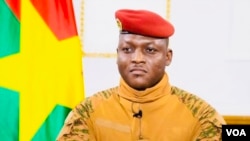
OUAGADOUGOU — Burkinabe authorities has suspended the issuance of export permits for artisanal and semi-mechanized gold and other precious commodities with immediate effect, the governing junta said.
Through a statement dated February 20, Burkina Faso's military junta said it looks to "clean up the sector."
The government has a "desire to better organize the marketing of gold and other precious substances," the statement added.
Burkinabe authorities have called on mining groups who have material to export to reach out to the National Society for Precious Commodities, SONAP, for compensation, the junta said.
Forum